
Responsible Conduct of Research
Responsible and Ethical Conduct of Research (RCR) Requirements
Education in RCR is considered essential in the preparation of future scientists and engineers. The responsible and ethical conduct of research is critical for excellence, as well as public trust, in science and engineering.
RCR involves not only a responsibility to generate and disseminate knowledge with rigor and integrity, but also a responsibility to:
- Conduct peer review with the highest ethical standards.
- Diligently protect proprietary information and intellectual property from inappropriate disclosure.
- Treat students and colleagues fairly and with respect
The goals of RCR education and training are to:
- Develop, foster, and maintain a culture of integrity in science;
- Discourage and prevent unethical conduct;
- Empower researchers to hold themselves and others accountable to high ethical standards;
- Increase knowledge of, and sensitivity to, ethical issues surrounding the conduct of research by researchers with diverse backgrounds;
- Improve the ability to make responsible choices when faced with ethical dilemmas involving research;
- Provide an appreciation for the range of accepted scientific practices for conducting research;
- Inform scientists and research trainees about the regulations, policies, statutes, and guidelines that govern the conduct of U.S. Public Health Service-funded research and promote compliance with the same; and,
- Promote a career-long positive attitude toward research ethics and the responsible conduct of research.
The subject matter of RCR training and education includes:
- Research misconduct and questionable research practices;
- Data management – i.e., data acquisition, record-keeping, retention, ownership, analysis, interpretation, and sharing;
- Scientific rigor and reproducibility;
- Responsible authorship and publication;
- Peer review;
- Conflicts of interest in research;
- Mentor/mentee responsibilities and relationships;
- Collaborative science;
- Civility issues in research environments, including but not limited to, harassment, bullying, and inappropriate behavior;
- Policies regarding laboratory safety, biosafety, and human and animal research subjects;
- Views about scientists as responsible members of society;
- Social and environmental impacts of research; and,
- Contemporary ethical issues in biomedical research.
NIH, NSF, USDA, and other federal agencies mandate that researchers participate in substantial in-person training in RCR principles.
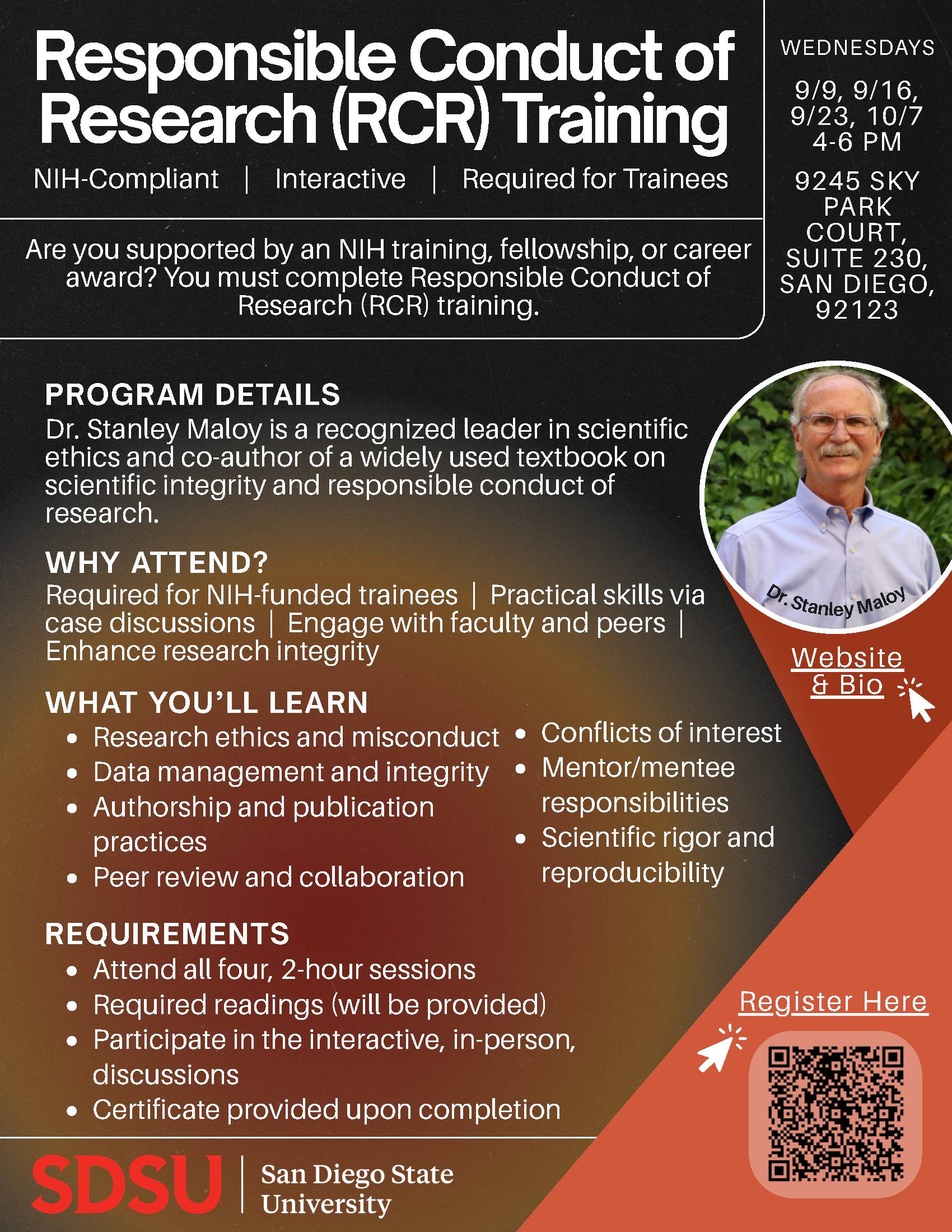
RCR Training Instructions
The Collaborative Institutional Training Initiative (CITI) Program provides responsible conduct of research (RCR) training and is the only accepted training certification for new and continuing investigator certification. Access the instructions below for information about which courses to take and how to create or update your CITI account to include your SDSU affiliation.
Add a Course
Scroll down to Question #4: Responsible Conduct of Research. Select the appropriate course based on your research or funding agency requirements. An average quiz score of 80% is required to receive a course completion certificate.
SDSU Research Misconduct Policy
The university's updated research misconduct policy will go into effect Jan. 1, 2026 to comply with legal requirements from federal funding agencies.