
Dr. Julio Fregoso
Postdoc in the Spotlight
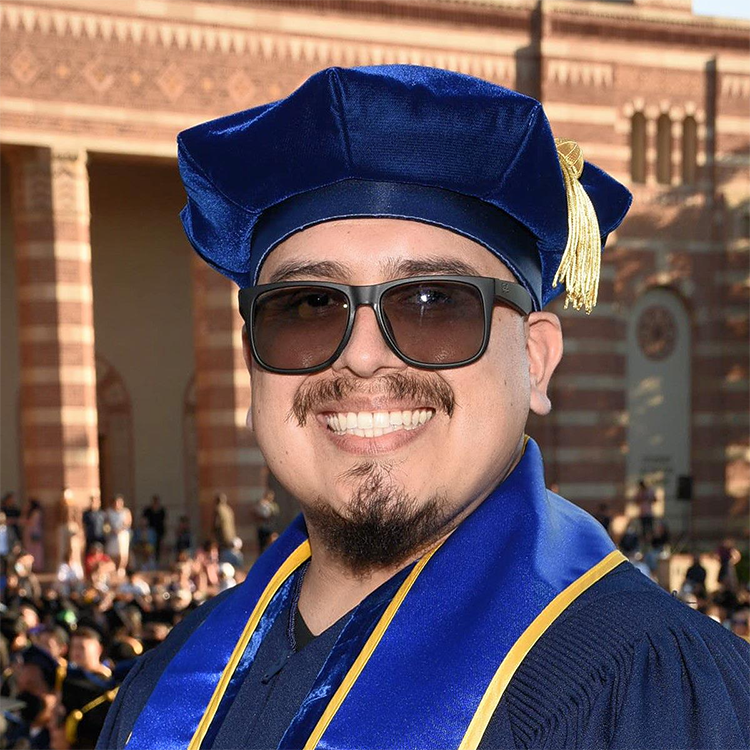
Dr. Julio Fregoso
PI: Dr. Felisha Herrera Villarreal
Area of Research: Postsecondary Education and Community College Leadership
Tell us about your scholarship: What questions is your work answering?
My research is deeply rooted in unraveling the experiences of marginalized communities in higher education. Central to my scholarship is an exploration of the challenging issues faced by community college (transfer) students of color in the United States, specifically examining how institutional characteristics and campus climates shape their academic journeys. This line of inquiry extends to a critical analysis of structural barriers confronting Black and Latine/x men in community colleges, a topic I thoroughly examine in my recent book chapter. Within such work, I delve into systemic definitions of academic merit and grit, evaluating their implications for equitable educational outcomes, notably in the context of aspirations for transferring to four-year institutions.
My research interests are diverse yet interconnected, spanning across the realms of community colleges, transfer student outcomes, and campus racial climate assessments, all with a keen eye on policy implications. Methodologically, I am committed to employing and further developing critical quantitative approaches that foreground race, ethnicity, and other marginalized identities. I plan to integrate these approaches with econometrics, spatial statistics, and big data visualization to offer powerful insights into the experiences of traditionally marginalized groups in higher education. This focus aligns with critical issues such as student success, persistence, and retention, particularly within community college settings. Moreover, my work extends to examining campus racial climates beyond the community college context, exploring their broader policy impacts across both two-year and four-year educational institutions.
Looking ahead, my research is increasingly oriented towards policy influence, a direction reinforced by my involvement in Pennsylvania State University's inaugural research-to-policy collaborative. This initiative, designed to boost the participation of Black, Indigenous, and other People of Color in policy work, resonates with my goal to blend academic research with practical policy applications. As part of this program, I am proposing a comprehensive econometric analysis of student loan policies, focusing on long-term financial well-being and the equitable distribution of loan accessibility and burden among diverse demographic groups. This project represents my commitment to connecting academic research with meaningful policy development, particularly in the spheres of entrepreneurship and economic policy.
What excites you about your current SDSU postdoc position?
As a Postdoctoral Research Fellow at the Research and Equity Scholarship Institute on Student Trajectories in Education (RESISTE), I have a distinct focus in my research. My work as a postdoc centers on examining the role of community colleges in fostering STEM pathways. Specifically, I along with other postdocs work to enhance Experiential Learning outcomes for Latine/x and other marginalized students. This study is particularly relevant for those enrolled within Hispanic Serving Institutions (HSIs) or emerging HSIs (eHSIs). What excites me about this role, is the unique opportunity to collaborate with other postdocs and student researchers at the center. Their unique perspective rooted in lived experiences offers a breadth of perspectives that inform the work we all do for the center.
What is your career trajectory and how is your current postdoc position helping you achieve that?
As a former first-generation college student, current first-gen postdoc, and former Pell-grant recipient, I am enthusiastic about the prospect of joining the faculty at a four-year college or university. My aim is to add to the groundbreaking work conducted by esteemed scholars of color, who inspire me in my field. A central element of my career goals is to mentor students from disenfranchised backgrounds, as I was guided by others. I hold a particular interest in tackling the challenge of math or quantitative anxiety. This issue often stems from veiled, institutional pedagogical approaches that inadvertently undermine marginalized students' confidence in their abilities. Such anxiety can profoundly affect students' perceptions and their capacity to effectively use quantitative methods in their research. My dedication lies in transforming these experiences into empowering opportunities for students to realize and harness their potential in quantitative disciplines (should that be their aspiration).