
Dr. Choudhury Abinash Bhuyan
Postdoc in the Spotlight
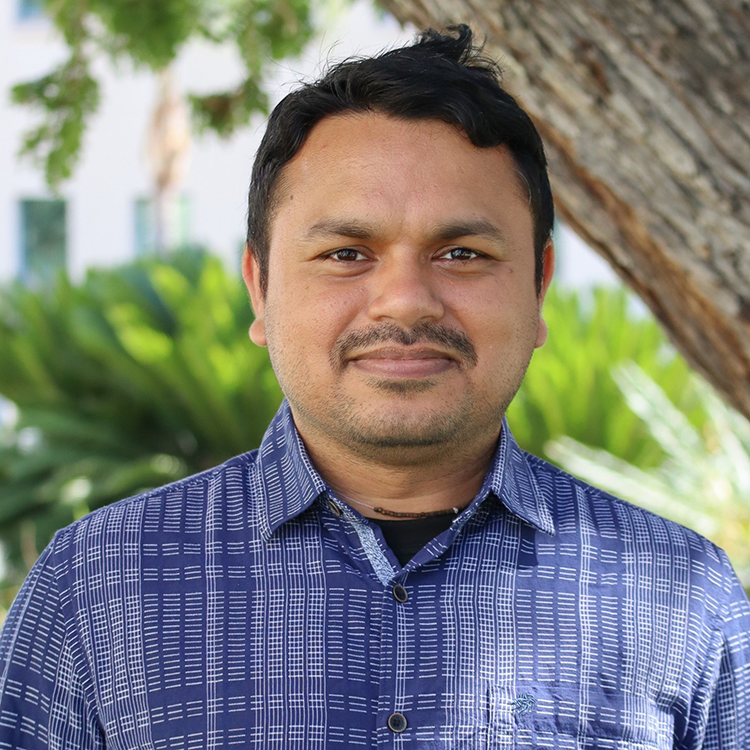
Dr. Choudhury Abinash Bhuyan
PI: Dr. Sanjay Behura, Associate Professor of Physics and Director of Photophysics of Quantum Materials Lab at SDSU
Area of Research: Engineering Spin and Exciton Qubits for Quantum Hardware
Tell us about your scholarship: What questions is your work answering?
My research explores how two-dimensional quantum materials can be engineered to power the next generation of quantum technologies. At SDSU, I work on two complementary material platforms: quantum defects (artificial atoms embedded in solids) in hexagonal boron nitride (hBN) and stacking-controlled transition metal dichalcogenide (TMD) moiré superlattices. These systems host distinct quantum states: spin qubits in hBN and exciton qubits in moiré superlattices, which have exciting potential for quantum sensing, secure communication, and integrated quantum photonics.
A central question driving my research is how we can design quantum materials so that their atomic structure, optical properties, and device performance are predictably connected. In hBN, I develop scalable chemical vapor deposition methods to control the materials with built-in single-photon emitters and investigate how defects interact with light. I also study how coupling these emitters to optical cavities enhances their performance and enables room-temperature quantum sensors. In parallel, I investigate how exciton qubits behave in TMD moiré superlattices under realistic operating conditions. By understanding how heat flow and charge transfer influence these quantum states, my research provides insights into building reliable quantum devices that operate beyond ideal laboratory environments.
Ultimately, my work bridges fundamental materials physics and practical quantum hardware. By understanding how quantum states emerge, interact, and can be controlled in two-dimensional materials, I aim to establish scalable platforms for future quantum sensing, communication, and photonic technologies.
What do you find most rewarding about your current postdoc role at SDSU?
The most rewarding aspect of my postdoctoral experience at SDSU is the opportunity to develop two-dimensional material-based quantum sensors in a highly collaborative and supportive research environment. Our group combines advanced device-grade materials synthesis with state-of-the-art optical characterization, allowing us to tackle fundamental scientific questions while developing technologies with real-world impact.
I also value the opportunity to mentor undergraduate and graduate students, collaborate with researchers across SDSU, partner with institutions in the MonArk Quantum Foundry, and contribute to projects spanning fundamental science and emerging quantum technologies.
What is your career trajectory and how is your current postdoc position helping you achieve that?
My long-term goal is to become a faculty member at a leading research university, where I can build an internationally recognized research program in quantum hardware. My postdoctoral position at SDSU is helping me achieve that goal by expanding my expertise in quantum materials synthesis, optical spectroscopy, and quantum sensor development, while strengthening my experience in student mentoring, interdisciplinary collaboration, research grant development, and technology commercialization. During my time at SDSU, I have had the opportunity to publish high-impact research, contribute to three U.S. provisional patent applications, and participate in the NSF I-Corps program, gaining valuable experience in translating fundamental scientific discoveries into emerging technologies. Receiving the SDSU Outstanding International Scholar Award (2026) has been a tremendous honor, recognizing my research contributions and motivating me to continue pursuing impactful research and innovation in quantum science.